- Welcome -
Tenth Continental
Bioregional
Congress
July 12-20, 2008
to be held at Grailville near the
Little Miami River in the
Central Ohio River Valley Bioregion
in Loveland, Ohio, not far from Cincinnati.
(This site is being updated to reflect changes for the upcoming 2008 event.
Your patience is appreciated.)
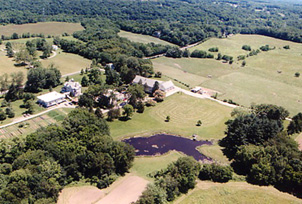
Grailville is a 300 Acre farm consisting of a retreat center, organic gardens, hiking trails, woods, pastures, ponds, and creeks, labyrinths, constructed wetland wastewater treatment system, and the future Heartland Ecovillage. The buildings have names like Oratory, Tidings, the Ark, and the House of Joy. Grailville has been an environmental, education, and retreat center since the 1940s, with a strong emphasis on women's issues, spirituality, ecological sustainability, and social transformation throughout the world.
For more information, email Mary Meyer or call 812-933-0067. If you wouldlike to assist with this exciting event, especially if youlive in or near the Ohio River Valley, you may join out listserv.
You are invited to join us in Congress

Across the planet, people recognize that we must become guardians of our life-places. Human beings have long understood that security is found in acting responsibly at home, in our neighborhoods and watersheds - our bioregions.
Bioregions are living systems where every being is connected to, and interdependent with every other; bioregions are not defined by property lines, states, or nations, but by rock, soil, weather, water, terrain, plants, animals, human cultures and human settlements.
Bioregionalism calls for active citizenship in the whole of life, the biotic community. While decentralist, Bioregionalism's key understanding is cultural: attention to place, to local history, natural history, and to how a community's hopes, wounds, and dreams can inform enduring ways of life that will heal and sustain the planet's bioregions and their inhabitants.
Bioregionalism cultivates learning the natural history of all our relations in order to craft diverse human societies respectful of place and planet.
Bioregionalism means working to satisfy basic needs locally, relying on renewable energy and sustainable agriculture, developing local enterprises based on local skills and strengths.
Bioregionalism challenges and is an alternative to nationalism, corporate rule, and top-down globalization of our lives.
Bioregionalism embraces the struggle to preserve, restore and enhance the life of the places that constitute the planet. Since 1984 bioregionalists have been gathering in congresses to envision and develop a realistic, restorative way of life in the bioregions of the Americas. We set our own agendas, operate by consensus and build a common commitment. Grand times and good friendships are only the first fruits. At bioregional congresses, we live in community, concern ourselves with the things that matter, and return home informed and inspired. We earnestly invite the participation of all, especially those actively employing ecological precepts in the many movements and endeavors necessary for the human species to reinhabit the bioregions of the Americas and of the whole Earth.

Any and all activists and practitioners in these fields are strongly urged to attend, to share their passions, lore, successes and learning experiences; to find new cohorts while participating in plenary discussions and spontaneous conversations.
If we are to avoid total ecological and social collapse followed by a brutal global monoculture, we need to begin to live by life, to listen to the planet, to learn our places. Home is the ground for honest hope. Only in our life-places can we begin anew, in the timeless way of Earth's ecologies.
The Congress Site
Grailville, in Loveland, Ohio (www.grailville.org ) near Cincinnati, is a 300 acre farm consisting of a retreat center, organic gardens, hiking trails, woods, pastures, ponds, and creeks, labyrinths, constructed wetland wastewater treatment system, and the future Heartland Ecovillage. With buildings with names like Oratory, Tidings, the Ark, and the House of Joy, Grailville has been an environmental, education, and retreat center since the 1940s, central to the Grail Movement's emphasis on women's issues, spirituality, ecological sustainability, and social transformation throughout the world.
For more information, contact Mary Meyer at or
812-933-0067. If would like to assist with this exciting event,
especially if you live in or near the Ohio River Valley, you may join
a listserv: " ."
Clans, Circles, and Councils, etc.
Over the years, bioregional congresses have evolved various forms of meeting and discussion. The primary commitment is to have an open agenda, set at agenda planning meetings each day, where anyone wishing to raise an issue for whole group discussion (plenary – see below) is welcome to do. There will be skilled facilitators at council meetings and plenaries and, as much as possible, Spanish-English translation will be provided.
Other functions and business of the Congress are met by various groups. You will probably find yourself in several of them:
Circles: Opening, Closing, and Morning Circles will bring us all together to make introductions, announcements, and connections.
Clans: You will be assigned to a small group that meets daily for personal sharing, and to work on a communal task, such as food prep, kitchen cleaning, recycling, or child care.
Councils on large subjects (such as Education, Political Action, Culture, Healing, etc.) will be held in the early part of the week, and possibly also committees whose focus is more specific than the councils.
Plenaries are full-group meetings in which reports are heard and proposals are presented. Decisions are made by consensus process.
Caucuses are special interest groups that spontaneously form to represent the concerns of groups such as women, men, youth, other species, etc.

Workday
A workday at the congress is being planned to allow participants an opportunity to honor the place of our meeting by giving something back. Participants may choose between various community and land restoration projects.
Cultural Celebrations
Every evening at the congress will feature a celebration of bioregionalism throughout the Americas: stories, songs, dance, drama, masks, costumes, slides, poetry -- whatever short (10 – 30 minutes) presentation you (and your bioregional neighbors?) invent and imagine to represent, evoke and celebrate natural and cultural community in your home place.
Pre-congress
Pre-congress activities will provide opportunities to tour, learn about the geographical and biological features of the region, or get an introduction to Permaculture and/or the Ecovillage Movement. Watch this website for evolving details.
Registration
You can really help this event flow more smoothly, if you pre-register (+ you get a discount for doing so). A confirmation packet will be mailed to you. Check-in will begin --------------------, --------------. The first meal will be served at -----------. The congress will end after lunch on --------------.
Contact Us
For copies of the invitation to the 10th Continental Bioregional Congress or details on registration please contact ----------------------------------------------.
For transportation from train, bus, or airport: --------------------------------------------------------------
Join our online bioregional listserv:
Subscribe:
Unsubscribe:
Post message: bioreg@yahoogroups.com
List owner: bioreg-owner@yahoogroups.com